Showing posts with label collaboration. Show all posts

Wednesday, March 21, 2012

Where are the midwives who practise privately?

[The following brief overview of private midwifery options is anecdotal, incomplete, and reported in good faith, knowing that situations change constantly.]

Western Australia
There are currently 11 Medicare-eligible midwives in WA, but how many are actually practising at the moment I’m not sure.  Some will do homebirths but others are only doing intrapartum care in hospital. 

There are currently no admittance/access rights for eligible midwives, so care in hospital is usually achieved through an arrangement by which the midwife is casually employed by WA health when she does the intrapartum care in hospital. WA Health are currently developing an access agreement.

There are 3 or 4 other privately practicing midwives in Metro Perth and two in the South West. I don’t think any are currently doing VBACs at home.  Some are only taking repeat clients. 


South Australia
The options in SA are limited because almost all of the midwives live in a similar geographical area. Most of us travel but it still is limited. Of the 9 working and taking on clients, 6 live in the Adelaide Hills and the next one coming into it also live up here.  There are 3 who are Medicare eligible, 1 eligible midwife about to start, 3 who are not eligible but are registered. 


Homebirth SA Blog
Facebook

Victoria
Midwives in Private Practice (MiPP) is a collective of midwives, and a participating organisation in Maternity Coalition. MiPP members work in Group Practices, partnerships, and solo practices, providing private midwifery services for women planning homebirth, as well as hospital births. MiPP members also mentor other midwives who are commencing private practice. Although Victoria is a relatively small State, there are areas where no private midwifery services can be accessed.

Recent government-funded homebirth programs have been offered for selected women through Sunshine and Casey Hospitals.

One Victorian Medicare-eligible midwife has completed a medications course which has been accepted by AHPRA. However, Victorian legislation needs to be changed before midwives are able to take up the PBS reforms.

In Melbourne more and more doctors are saying "no" to women who request referral or another pathway so that the woman can receive the Medicare rebate.  The government’s reform is pretty empty if women can’t even access Medicare rebates.   An obstetrician at the local hospital told me “I don’t support that model”

MiPP blog
List of MiPP midwives

New South Wales
Northern NSW - there were about 8 midwives attending homebirths a few years ago, with maybe 3 being private practice (PPM) only, and the other midwives also working in public hospitals. Now there are no PPMs-only in this region, but there is one midwife who attends some homebirths and is also employed in a hospital, and one other midwife who is Medicare eligible and attends some homebirths and is also a caseload midwife. There is another PPM who lives on the Gold Coast Qld and travels to the region. We have also had a govt funded homebirth program approved here which should be up and running shortly. That may impact further on numbers of births available for PPMs. 
Marie Heath (Goulburn)

Queensland
Toowoomba-Ipswich My Midwives offer women the choice of 4 midwives in Toowoomba and 2 in Ipswich.  We also have a lactation consultant who just does lactation privately but is an eligible midwife (provides antenatal and labour as an employee in hospital).  Women can choice place of birth (home, birth centre, public hospital).  They only receive a Medicare rebate for birth for birth centre or public hospital.  They receive Medicare rebates for antenatal and postnatal care no matter where they have their baby.  Many of the private funds provide a rebate for some element of the woman’s care as well if the woman has private health insurance. 

We bulk bill completely women attending Young Women’s Place for antenatal and postnatal care and we can attend women admitted as public patients under a fractional employment model with the hospital.  The tendency though is not to admit women as public patients unless we have to because we do find that having them admitted as the primary client of the midwife rather than as a public patient makes a difference in terms of autonomy in the woman’s care.

We have a signed collaborative agreement with Toowoomba public hospital obstetricians.  In practice one of us [midwives] meets with them fortnightly to discuss any issues we have or we book women in at a specific time for a referral or consultation.  At the time of admission the women are admitted in the care of (or “under”) the primary midwife and we consult if/as required with one of the obstetricians.  For women birthing at home, we just attend as normal and let the hospital know if we have any dramas.
My Midwives

For more links to websites of privately practising midwives, go to Midwives Australia

Sunday, February 26, 2012

Arranging collaboration

Each time a Medicare-authorised midwife agrees to work with a woman in providing midwifery services we have to navigate the sometimes-challenging terrain of collaborative arrangements'.

Without a collaborative arrangement that meets the requirements set down in the National Health (Collaborative arrangements for midwives) Determination 2010, the midwife is not permitted to offer a Medicare rebate for services. The degree of ease or difficulty experienced in reaching tick in the collaboration box varies from woman to woman. In last week's blog post I listed some of the situations that midwives have faced in attempting to arrange collaboration, ranging from simple and workable, to outright obstruction by a medical practitioner.

A midwife who has recently obtained her Medicare provider number, and who is setting up private practice for the first time, has decided to focus on postnatal midwifery services, rather than primary midwifery care that spans the prenatal, labour and birth, and postnatal episode of care for individual women. The midwife contacted the Medicare office, and reported:
"they [Medicare] don't need collaboration, all they want just referral from a doctor."

"the doctor can be a GP who does not have the diploma of obstetrics."

"also called the two insurance companies, who confirmed, no need for a collaborative agreement for postnatal, only referral from a doctor which could be a GP who initially made the booking in."

This apparently conflicting advice highlights the need for a serious review of the government's Maternity Reform package and the associated bureaucratic processes. There is no differentiation made in the legislation between prenatal or postnatal midwifery services; they all come under the same set of requirements. It is ludicrous for the Medicare office to tell a midwife that "You don't need collaboration, only a referral from a doctor." The referral letter IS the collaboration arrangement, according to Section 5 (1) (b) of the Determination.

Midwives who seek to meet the Medicare-related requirements take the relevant legislative instruments into consideration in preparing a care plan for each woman. Using a highlighter, here is a summary of two new laws which impact on midwifery services:

For each episode of care, the midwife needs to consider:
1. National Health (Collaborative arrangements for Midwives) Determination 2010 [NH(CM)] 
2. Health Insurance (Midwife and Nurse Practitioner) Determination 2010 [HI(MNP)]

Specified Medical Practitioner for this episode of care: _____________________________________

Collaborative agreement or arrangement under Section 5 NH(CM): ______________________

5 Collaborative arrangements — general
(1) For the definition of authorised midwife in subsection 84 (1) of the Act, each of the following is a kind of collaborative arrangement for an eligible midwife:
(a) the midwife is employed or engaged by 1 or more obstetric specified medical practitioners, or by an entity that employs or engages 1 or more obstetric specified medical practitioners;
(b) a patient is referred, in writing, to the midwife for midwifery treatment by a specified medical practitioner;
(c) an agreement mentioned in section 6 for the midwife;
(d) an arrangement mentioned in section 7 for the midwife.
If the collaborative arrangement is (d) above [Section 7 midwife’s written records] 

(1) (a) the (specified) named medical practitioner(nmp): _________________________ 
(b) Midwife has told the patient of collaborative arrangement with nmp: 
(c) acknowledgement by nmp: 
(d) plans for consultation, referral, and transfer of care to nmp: 
(2) (a) record of any consultation or other communication with nmp: 
(b) record of any referral to nmp: 
(c) record of any transfer of care to nmp: 
(d) acknowledgment of receipt by nmp/hospital of booking: 
(e) acknowledgment of receipt by nmp/hospital of maternity care plan: 
(f) record of imaging& pathology results to nmp: 
(g) discharge summary to nmp and usual general practitioner

MIDWIFERY SERVICES [HI(MNP)] 
• Practice arrangement [HI(MNP) 4(2)(a)] for midwife with primary booking in this care plan: partner / employee / [other] ___________
• Other midwife who provides relief services or locum [HI(MNP) 4(2)(b/c)]:
• Requirement [HI(MNP) 6] for collaborative arrangement has been met:
• Requirement [HI(MNP) 7(1)(a)] service has been met:
• Requirement [HI(MNP) 7(1)(b)] (not employed) has been met:
• Labour and delivery [HI(MNP) 8] requirements (1) to (4) have been met if applicable:


In addition, a midwife who intends to attend a woman for birth in the home is required to have the woman sign an agreement, in which the woman acknowledges that she understands that there is no professional indemnity insurance for home birth, and that midwives are exempt until 30 June 2013 from having insurance for homebirth.

These are just a few examples of the new and complicated terrain that privately practising midwives in Australia must navigate.  In time midwives will face audits and investigations, and will be held accountable for the way we practice.  Midwives who wish to discuss practice in more detail with their peers are invited to join Australian Private Midwives Association (APMA), and contribute to APMA yahoo! group email discussions.

Wednesday, February 22, 2012

Assessing progress with Medicare

Let's review and assess private practice midwives and Medicare!

In the past year midwives who have the 'eligible' notation against their name on the Midwives Register have been able, in theory at least, to facilitate Medicare rebates to women in their care. The common process is that the receipt issued by the midwife contains the midwife's Medicare Provider Number, the name and address of the practice as it is registered with Medicare, and the Medicare Item number(s) for services provided.  The woman/client receives rebate of the scheduled fee plus any addition rebate under the Extended Medicare Safety Net scheme.

The Health Insurance (Midwife and Nurse Practitioner) Determination 2011 - F2011L02162 is the legislation that gives detailed description of the Items and the current level of the scheduled fee for midwifery services, from which rebate is calculated.

Australian Private Midwives' Association (APMA) has asked members to provide information about how they are traveling in the new 'Medicare eligibility' terrain. Understandably, much of the response has focused on the requirements of the new legislation for a collaborative agreement or arrangement with a named, specified obstetric medical practitioner - all of which is defined and directed in the law. The midwife is required to demonstrate and record suitable collaboration in order for Medicare rebates to be available to the woman, but there is no linked requirement, or even encouragement, for any doctor to reciprocate when collaboration is requested.

Some midwives are situated in communities where doctors and even public hospitals are willing to enter collaborative arrangements with private midwives. The midwives are getting on with the job of being with woman; the women are receiving expert midwifery care from their own midwives through the continuum, as promised by the Health Minister when the maternity reform package was announced, and receiving significant Medicare rebates for the midwifery services.

However, midwives practising privately in other communities, such as densely populated big cities, or covering rural towns and villages, face multiple challenges each time they attempt to comply with the collaboration law. Here are a few quotes from midwives' responses.

[The collaboration requirements are]
"absolutely unreasonable. We are qualified competent midwives who should not be held to ransom by our medical colleagues. It is mainly unworkable and my clients are having to travel all over the place to get an agreement and they pay a new patient fee and then are told ‘oh no I’m not doing that now’ even though the doctor signed an agreement with another client the week before. It’s not fair on the doctor either as they often don’t understand they are not required to do anything and if there are any deviations from normal then we consult directly with the [backup] hospital. Doctors often say there’s no point to this because we’re doing the same thing and doubling up and it’s not required for a healthy uncomplicated pregnant women. I say "I KNOW, but can you just sign anyway" because it’s just a formality and a requirement until we get the legislation changed!!"
[The collaboration requirements]
"should not have such and emphasis on the midwife being subservient to the doctor. It should also provide an incentive for a doctor to want to collaborate with us!"
[The collaboration requirements]
"are not necessary - we had the same system of referral and transfer here before Medicare and it worked fine but it was not formalised. Now it takes extra time and the doctor has the power to veto - this is not acceptable."

Collaboration can be a relatively simple matter.  A letter of referral (one of the processes by which collaboration is demonstrated) from a doctor Melbourne, who had not previously met this woman, wrote to the midwife:
"Thanks for caring for <M>  for the antenatal and postnatal period of her pregnancy.  She is well.  I am happy to provide collaborative care."   
On the other hand, an obstetrician, who is a senior consultant at a public maternity hospital has said:
"I am not comfortable with this model of care (ie private midwife).  If <M> wants a private midwife she will need to make a booking at [public] hospital, and have all her care under that system.  Any additional care she wants from a private midwife will be at her own cost.  I will not sign a collaborative arrangement."
The midwife, and the woman, must return to the drawing board, seeking a way to meet the collaboration requirements.


Readers are welcome to make their own assessment of progress in the midwife-Medicare labour.
Midwives assess progress (of this labour) externally, and the external features that can be noted include the fact that some women are claiming rebate on midwives' fees.  The amount of this rebate could be up to $1000 per woman/episode of care.

Midwives also assess progress internally, and the internal signs of the Medicare labour are not good.  The efforts made by some obstetricians to isolate and exclude private midwifery, blocking what little financial assistance the woman is entitled to, will lead to distress and obstruction.  The people who will suffer most are the mother and her baby.


Thankyou for your comments.

Wednesday, June 29, 2011

Collaborative arrangements

Midwives providing services eligible for Medicare rebates are required to have evidence of a collaborative arrangement with a specified medical practitioner for each woman in their care. In essence, the midwife is required to have written records of:
(a) the name of at least one collaborating medical practitioner;
(b) that the midwife has told the woman ["patient"] about the arrangement;
(c) acknowledgement by a named medical practitioner that the practitioner will be collaborating in the woman’s care;
(d) plans for the circumstances in which the midwife will consult, refer, or transfer care to that medical practitioner.

Midwives who have contacted the Department of Health and Ageing (DoHA) have given examples of situations in which collaborative arrangements have been difficult to obtain. The hurdle that is proving particularly difficult is (c) acknowledgement by the doctor that he/she will be collaborating. Doctors who have for many years worked collaboratively alongside midwives have baulked at the idea of putting their signature on a collaboration document.

Many midwives attending homebirths privately have for many years had good collaborative arrangements with public maternity hospitals. If a woman or baby in the midwife’s care requires transfer to hospital, or referral for specialist assessment in pregnancy, the process of consultation, referral and transfer is straight-forward, which is in the interest of the wellbeing of mother and baby.

For example, when the woman and midwife have completed the hospital booking-in process, the hospital gives the woman paperwork with the woman’s name on it, clearly marked ‘HOMEBIRTH BACK-UP’. This is evidence of the collaborative arrangement, but at present this sort of arrangement cannot be used as evidence of collaboration for the purposes of Medicare rebates.


In response to midwives' letters to the DoHA, Rosemary Bryant (Chief Nurse and Midwife) wrote:
The Australian Government, through this Department is continuing to monitor these difficulties through a range of activities including monitoring correspondence received- including your email, calls to our hotline and data from Medicare. We will also be undertaking surveys of midwives, obstetricians and GP obstetricians in the coming months to ascertain what is working, what is not working and then we’ll develop responsive action accordingly. Through our evaluation activity we’ll also be talking to pregnant women, women planning pregnancy and their families, about their experiences and awareness of the reforms to maternity services more generally.

I can assure you that the Government is committed to increasing choice of and access to maternity services in Australia, and maintaining our high standards of safety and quality through supports for workforce and infrastructure.

With reference to reports that doctors are reluctant to enter collaborative arrangements with midwives because of indemnity insurance concerns, Ms Bryant stated:
The Government has put in place arrangements that allow eligible midwives to obtain solid and affordable professional indemnity insurance cover that provides peace of mind for midwives and their clients. The Commonwealth-supported cover, which is provided through insurer MIGA (www.miga.com.au) is, in effect, unlimited. It covers eligible midwives for their full scope of practice, except intrapartum services in relation to planned home births. Obstetricians, GPs who provide obstetric services and hospitals can be confident that the Commonwealth-supported MIGA product provides strong, reliable professional indemnity cover for privately practising midwives. Therefore, from an insurance perspective, collaborating with a midwife who has the benefit of Commonwealth-supported cover is no different from collaborating with another medical practitioner who holds their own medical indemnity insurance cover.


Comments are welcome

Tuesday, November 2, 2010

Collaborative arrangements for midwives

Earlier posts on this blog and others have sought to tease out some of the issues that have been brought to light with the Australian government's attempts at reform of maternity care.

Since mid-2008, with the announcement of the Maternity Services Review, midwives and birthing activists have written and argued and pleaded for improvements that are based on evidence and women's rights.

That campaign is ongoing. There is plenty of work to be done.

Some midwives are now seeking to take up the offer of Medicare (MBS) and limited prescribing rights (PBS) that have progressed through legislation, and are now being implemented.

Each midwife has some serious hurdles that we will need to overcome in order to be granted these 'privileges', and enabling our clients to claim Medicare rebates on services that are linked to Medicare items. Perhaps the most challenging is the requirement, spelt out in the National Health (Collaborative arrangements for midwives) Determination 2010 for an authorised midwife to have a signed collaborative arrangement with a doctor, or alternatively to follow a lengthy and prescriptive documentation process.

Of the options for signed arrangements, the first option is that the midwife is employed by the doctor or doctors. This is not a likely option for midwives who practise privately in communities. Obstetric group practices already employ midwives in their rooms, and these midwives probably provide valuable assistance in seeing the large numbers of women who pass through the rooms. But it is doubtful whether, even if these midwives are granted eligibility for MBS and PBS, they will be encouraged by their bosses to practise authentic midwifery, including practising on their own authority, promoting normal birth, and working in partnership with women throughout the episode of care. These midwives are likely to continue as obstetric assistants: some may scrub to assist at caesareans; some may even take on a caseload. But unless they are practising in true co-labor, as professionals in their own right, the 'reforms' are unlikely to make any changes to maternity care standards or outcomes.

The second option for signed arrangements is that the woman is "referred, in writing, to the midwife for midwifery treatment by a specified medical practitioner". This option is quite fascinating. The obvious question is, why would a "specified medical practitioner" - a doctor who makes a living that is proportionate to the number of women who receive private maternity services from him or her, refer a woman to a midwife? This option will require strong women who approach these doctors, armed with their own plan, and request a referral that meets the requirements for collaborative arrangements.

The third option for signed arrangements appears to be the one that may be suitable for midwives who are practising privately and attending home births. This option will require the specified medical practitioner to be "a medical practitioner employed or engaged by a hospital authority and authorised by the hospital authority to participate in a collaborative arrangement." In this scenario the doctor who signs the arrangement may not be the doctor who provides collaboration in situations when women in our care, who are planning home birth, are referred to the hospital for obstetric review, such as for prenatal assessment or monitoring, or transfer of care. The doctor who signs the agreement with the midwife may be the medical director or head of obstetrics in a public hospital, who delegates the "authority to participate in collaborative arrangements" to the obsterics registrar. Such collaboration is applicable to the midwife’s provision of private prenatal care, and postnatal care. There is no Medicare item number for intrapartum midwifery care in the community (homebirth), so collaborative arrangements are not required to cover home birth.

Midwives who contact their local public hospitals with the purpose of seeking a signed collaborative arrangement are encouraged to communicate with APMA, or MIPP, in reporting the responses of the hospitals. These responses will be important information that will be used in reviewing and revising the legislation in the coming year(s).

Monday, November 1, 2010

Press release from Minister Roxon

From MinisterRoxonMedia@aph.gov.au

The Health Minister says:
"PATIENTS WIN AS NURSES AND MIDWIVES ACCESS MEDICARE AND THE PBS
[Comments and highlighting added by the blogger]

Nurse Practitioners and Midwives will from today be able to access the Medicare Benefits Schedule and provide Pharmaceutical Benefits Scheme medicines in the community.

For the first time highly skilled Nurse Practitioners and Midwives will be able to provide taxpayer subsidised services to patients outside of the public system in medical practices and the community.
[Blogger: We don't know of any midwives who have been successful in their applications for Medicare and PBS.  Readers are asked to provide links to any press releases that may identify midwives who have been awarded Medicare provider numbers
ps - one midwife has informed APMA that she is now 'eligible'/]

This is a momentous day for the nursing and midwifery professions and a great day for patients who will be able to claim a rebate, and benefit from better access, closer to home in a wider range of settings.

[Blogger: Home birth is not included in the Medicare reforms.  Women planning home birth may be able to get Medicare rebates on midwives' charges for prenatal and postnatal care, but not for birth.  The only Medicare  rebates for birth are for birth in hospital, attended privately by the midwife who has visiting access arrangements with the hospital, and collaboration arrangements with a named medical practitioner.]

...
Midwives will be able to deliver maternity care, including antenatal and postnatal care in the community, and undertake deliveries in a hospital.
 
...
Nurses and Midwives will be required to work in collaboration with medical practitioners when providing MBS services and PBS prescriptions.

[Blogger: Medical practitioners are not required to work in collaboration with midwives.]   


For today's article Medicare extended to nurses, midwives by Mark Metherell in The Age, click here.

Sunday, October 10, 2010

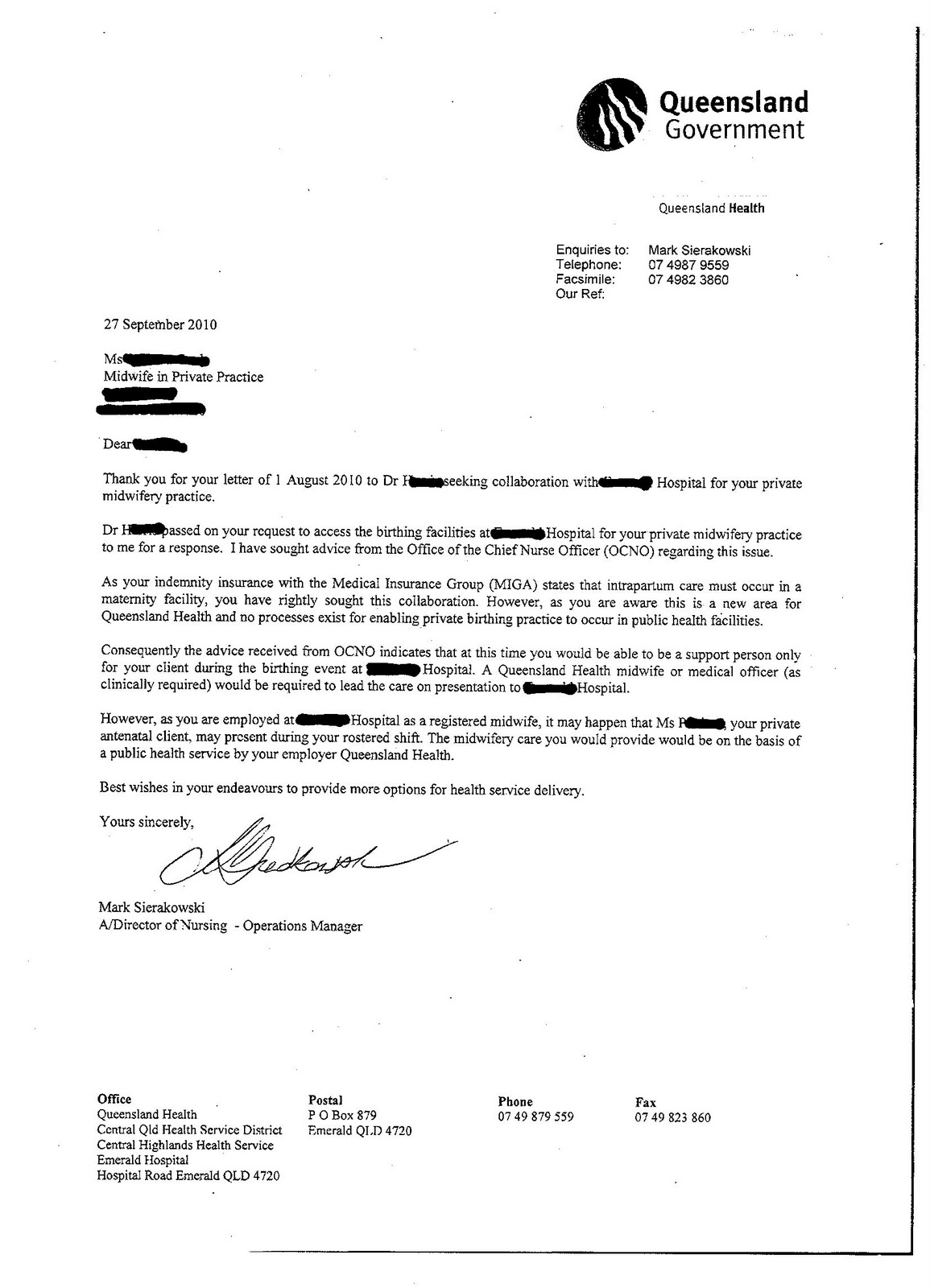
'midwifery models of care' in rural Queensland

[This account has de-identified the midwife and location.  It is a clear example of the ridiculously restrictive environment in which midwives are required to practise.]
Letter

I have had various discussions with managers/project officers who are attempting to roll out hybrid 'midwifery models of care' for the rural sector. From my own personal observations -

  • It is clear that GP's are the primary carer with the midwife as the after thought so as not to upset them.
  • GP's are scared they will lose an income stream to their rural practice often with the right to private practice to the local hospital.
  • Managers do not want to lose the doctor as the rural community backlash will be fast and vicious (rightly so).
  • Higher places of office are providing non-reassuring advice to the facility managers, happy to provide details specific to my application verbally.
  • It is clear managers are thinking they can switch a midwife's hat on for a few hours of the day to provide antenatal care or birth care. Essentially they are employed as a nurse first.
  • It is clear until nursing workforce shortages are addressed there will be no change in practice in rural areas that ensure continuity of care with a known midwife as midwives 'offering' themselves to be in these new models are still being put on rosters and not annualised salaries plugging up nurse shortages. Burn out for midwives will occur rapidly.

Geographical boundaries in keeping care within local communities to ensure the care is local, owned by the consumer and feels safe (Rebirthing Report) are being ignored in the drive for efficiencies in combining some projects when viewed in a remote office in some districts.

Collaboration for homebirth with a General Practitioner

A well known Melbourne GP, Peter Lucas, has attended homebirths with midwives for many years.

An excerpt from his website:

“For some 35 years Dr Peter Lucas and Wattle Park House has offered collaborative care with home birth families and the midwives they have chosen to assist them with their experiences.
"This will continue but assumes that the Wattle Park House medical practitioner attends the birth.
"Until midwives obtain full indemnity cover which includes the labour and delivery, collaboration at a distance is fraught with uncertainty in a medico-legal sense, and cannot be seriously entertained.”


Midwives are concerned that although this doctor is willing to enter what has been called a "collaborative" arrangement with a midwife, he (or his insurance company) are setting conditions on his collaboration and transferring the primary carer role from the midwife to himself. If midwives were to enter into agreements with Peter, they would no longer be the primary carer for their own clients. The arrangement negates the notion of continuity of care from the midwife who practises on her own authority, and renders useless the process of applying for Medicare/PBS eligibility for these women for their antenatal care, as the doctor will be providing that.